Written by: Alina Corona, Communications Lead
When most people hear the name “Samsung,” they think of smartphones, TVs, or home appliances like a washing machine. But Samsung isn’t just the microwave in your kitchen. Samsung SDI America is a leading player in the battery cell manufacturing industry, and through their support, we have integrated their technology into our Battery Workforce Challenge project, pushing our work to the next level.
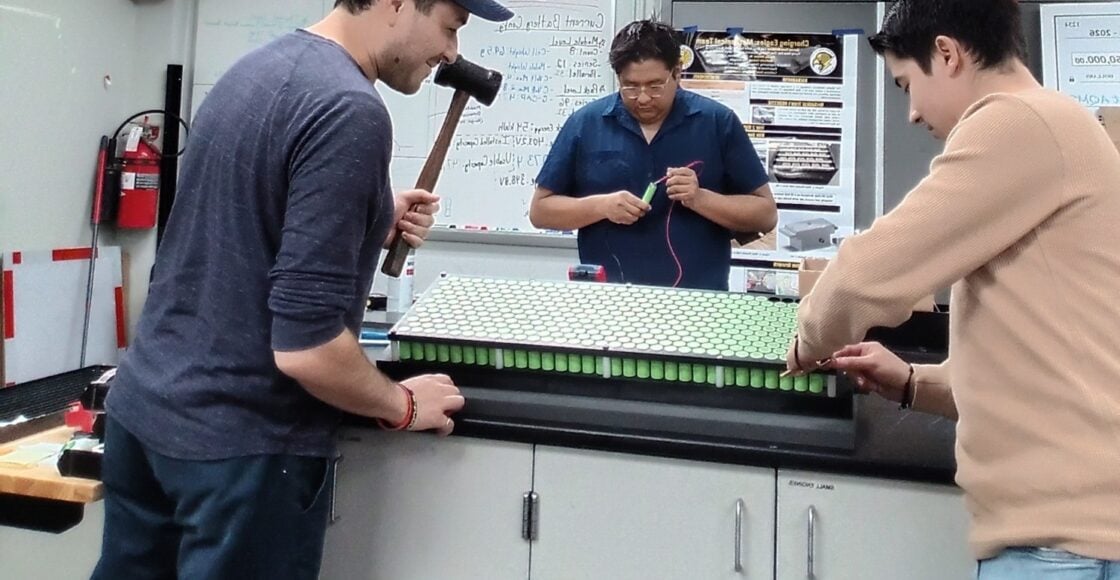
As our sponsor, Samsung SDI America supported The Charging Eagles by providing one of the most critical components of our project: batteries! They supplied INR 21700 battery cells that operate within a voltage range of 2.85 to 4.2 volts, forming the electrical foundation of our modules and overall pack. The 21700-form factor shaped our module layout and enabled us to meet the vehicle’s 54-kWh installed energy requirement. Working with these industry-grade cells gives us firsthand experience that prepares us for careers in the electrified workforce.
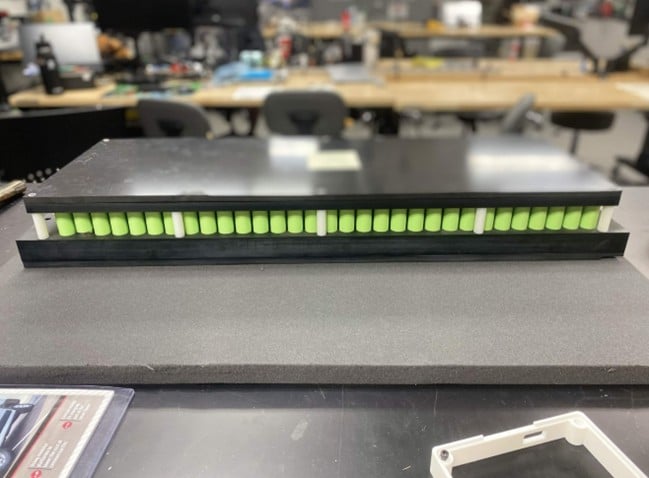
Integrating these high-energy cells required careful attention to safety. Even a single energized module contains significant stored energy, requiring strict PPE and disciplined safety protocols. To maintain safe temperatures, we incorporated cooling plates designed through calculations by our very own Arthur Espinosa, the thermal lead for The Charging Eagles. These cooling plates, just like the name implies, regulate cell temperature to maintain consistent performance.
In addition to supplying the cells, Samsung SDI America provided documentation outlining specifications, handling procedures, and safety guidance, including thermal runaway response. This support helped us establish disciplined storage, handling, and testing protocols while reinforcing industry-level safety standards.
Working directly with these cells has provided our team with exposure to real battery system validation. “Working with Samsung SDI cells has changed how we approach safety and validation,” said Geoffrey Chavez, Project Manager at Cal State LA. “Through my research, I’ve cycled these cells extensively — charging, discharging, and studying their behavior under stress. They’re incredibly robust, but they demand disciplined safety practices. That balance shapes how we design and test our modules.” In addition to cycling the cells, Geoffrey is developing an algorithm to estimate their state of charge, helping integrate chemistry and electrical engineering concepts into our design process.
This experience extends beyond research and into hands-on technical training. “Before joining this team, I didn’t realize how many different battery chemistries and form factors exist in the industry,” said Caleb, Vocational Student at Cerritos College. “Seeing a pallet of nearly 4,000 Samsung SDI cells delivered to the university was eye-opening. Learning how they’re stored, handled, and integrated into a real vehicle program changed how I view battery technology and manufacturing.”
As we move toward full pack integration, we’re proud to build on Samsung SDI America’s technology while developing the next generation of battery engineers and technicians. Partnerships like this show that innovation isn’t built in isolation — it’s built through collaboration, trust, and hands-on experience. We are grateful for the opportunity to work with industry-grade technology as we enter the workforce.