Virginia Tech EcoCAR: Our Favorite Tools and Software That Got Us Through Year 4
Home / News & Media / Virginia Tech EcoCAR: Our Favorite Tools and Software That Got Us Through Year 4
Written by: Lilly Nguyen
Virginia Tech’s EcoCAR vehicle design team spends the competition year transforming a stock Cadillac LYRIQ into a more efficient, intelligent vehicle. This work is made possible by the software and hardware generously provided by our sponsors. These tools form the technical foundation of our efforts, enabling us to design components, validate performance, and implement advanced, connected, and automated features in an engineering-focused environment.
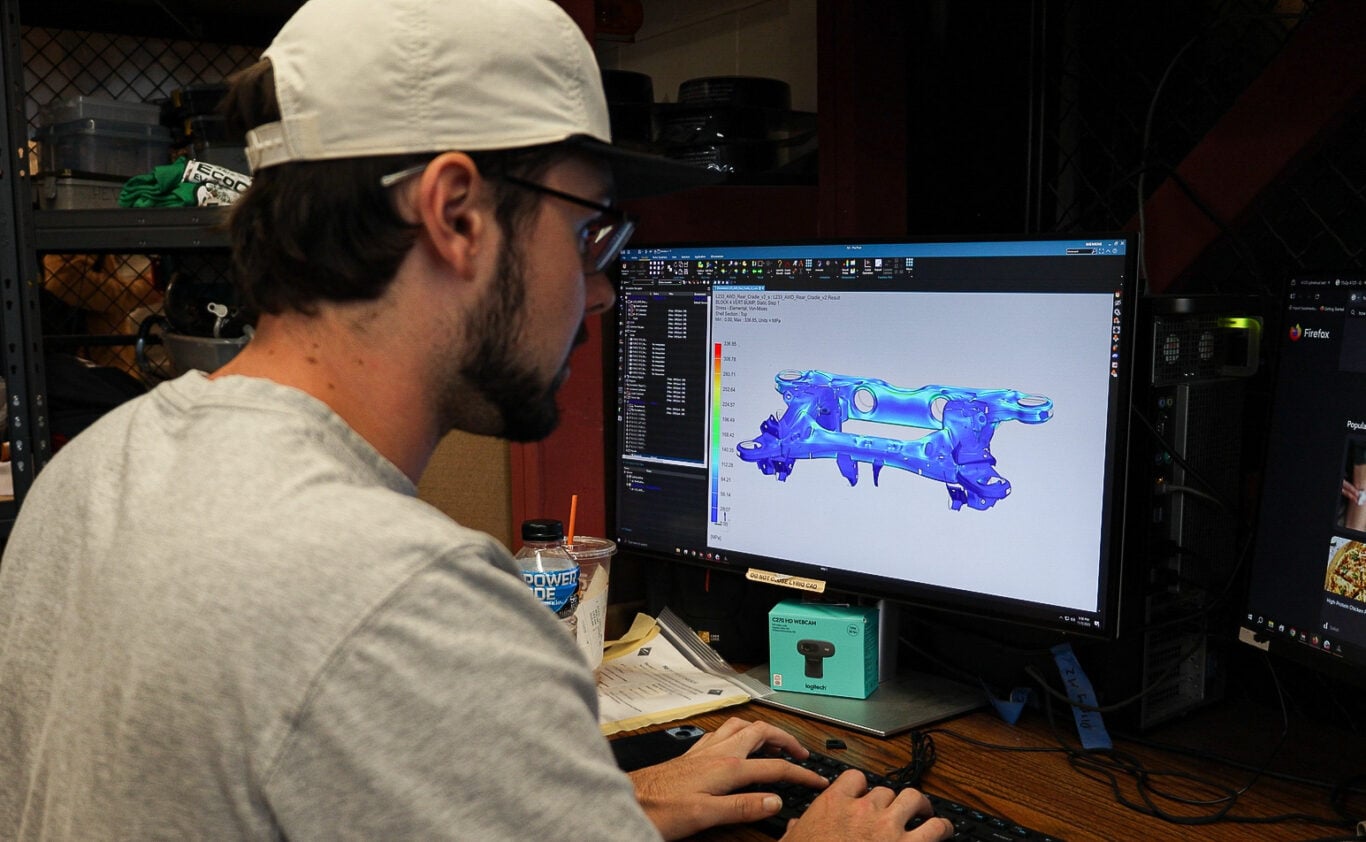
HEVT member Joseph Askew utilizes the Siemens NX software to perform a structural analysis of the LYRIQ’s subframe. This ensures the subframe is safe for use and reduces risk to mechanical components.
One of our most impactful resources is the Siemens NX CAE software suite, provided to the team for use throughout the EcoCAR Challenge. The System, Design and Integration (SDI) sub-team relies on this platform daily to create detailed 3D models of custom components such as motor mounts and brackets. Using Siemens NX, the team can perform virtual tests to evaluate the strength and durability of these parts and to understand how they will respond to loads, heat, and airflow. This process allows us to identify potential issues early and refine designs before any parts are manufactured. As Andrew Carella from SDI notes, this capability “allows us to continually refine our designs so they are safer, lighter, and better suited to our vehicle’s needs.”
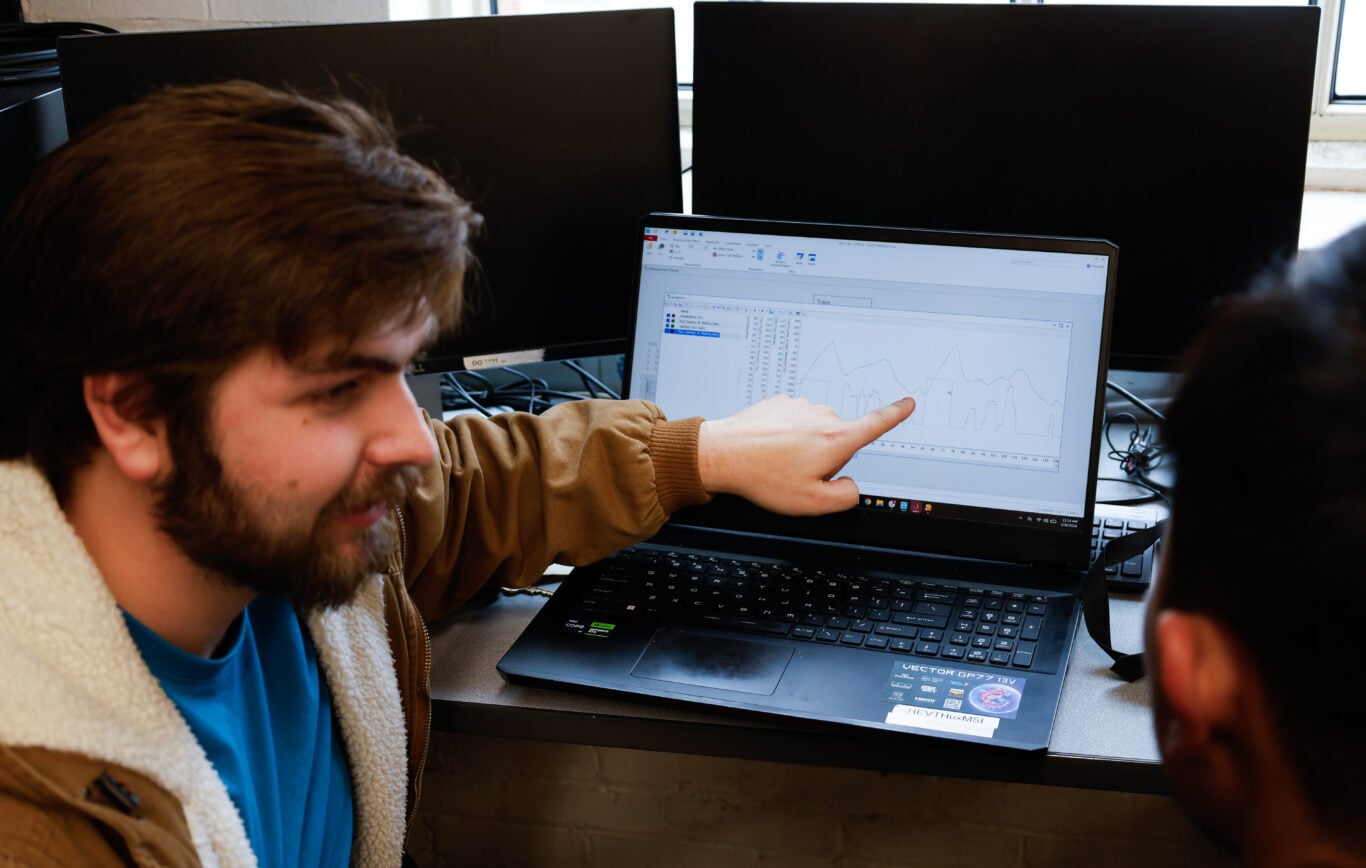
After components are designed, it is essential to understand how the actual vehicle behaves in real-world conditions. The Propulsion Controls and Modeling (PCM) sub-team uses a GL2400 data logger from Vector to capture messages on the vehicle’s internal communication network, known as the CAN bus, while the Cadillac LYRIQ is operating. Vector’s software tools allow the team to record, review, and analyze this data to monitor system performance and diagnose issues within various subsystems. Tony Weng from PCM states that these tools “enable us to efficiently process large amounts of vehicle data and quickly identify how our changes impact performance.”
HEVT members Yates Kirby (left) and Sovan Yuth Yun (right) use Vector’s GL2400 Data Logger to analyze vehicle testing, identifying areas for improvement in drivability, energy efficiency and one pedal drive.
The Connected and Automated Vehicles (CAVs) sub-team focuses on developing advanced driver assistance and connectivity features. The team uses the AUTERA system from dSPACE as the primary onboard computer to run its control software. In addition, Cohda Wireless radios provide vehicle-to-everything (V2X) communication, allowing the vehicle to exchange information with traffic signals and surrounding vehicles. This data supports features such as Cooperative Adaptive Cruise Control (CACC) and Automatic Intersection Navigation (AIN), which aim to improve energy efficiency and decision-making on the road. Parth Pandya from CAVs explains that “the importance of V2X communication is highlighted by a dedicated competition event, the Connected Driving Evaluation, which assesses how well teams use this technology.”
Together, the tools and components donated by Siemens, Vector, dSPACE, and Cohda Wireless are central to the success of Virginia Tech’s efforts in the EcoCAR Challenge. They enable a professional-level engineering workflow, from initial design through testing and validation, while also providing students with hands-on experience using technologies common in the modern automotive industry.