Written by: Lisé Badeaux
Before beginning her career as a Signal Integrity Engineer for iPhone at Apple, Nilovna Sinha gained hands-on experience solving complex engineering challenges as a member of the Georgia Institute of Technology EcoCAR EV Challenge team. From working on vehicle control strategies to learning how individual engineering decisions affect an entire system, her time in EcoCAR helped build an approach to problem-solving that she continues to use today.
Nilovna joined Georgia Tech’s EcoCAR team during the first year of her master’s program after previously working in the automotive industry in India. At the time, her coursework was in the areas of control systems and power electronics, but EcoCAR gave her an opportunity to apply what she was learning in the classroom to real-world engineering challenges.
“What really drove me to the EcoCAR EV Challenge was just being able to take what I was learning in the classroom and apply that to real engineering problems,” Nilovna said. “EcoCAR really helped me become a better engineer by providing me a platform to apply whatever I was learning.”
As a member of Georgia Tech’s Propulsion Controls and Modeling (PCM) subteam, Nilovna gained experience understanding how electrical engineering, controls, and vehicle-level considerations come together within a complex system. One project she remains particularly proud of was her work on torque-splitting strategies for the team’s Cadillac LYRIQ.
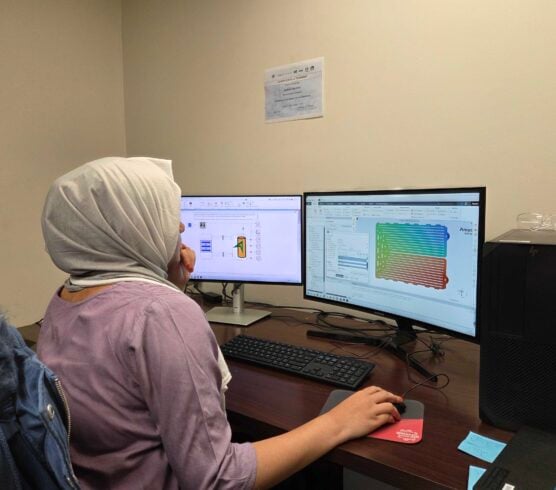
For an electric vehicle with multiple motors, torque splitting determines how torque is distributed among them, ultimately affecting factors such as energy efficiency and overall vehicle performance. Nilovna studied various torque-splitting algorithms, explored potential improvements to the team’s initial strategies, and helped develop a controller that could be tested via simulations under different driving conditions.
Nilovna said, “I had to understand how the decisions at the motor or controller level affect the performance of the entire car and system as a whole. That understanding is something that I’ve taken with me into my career today.”
Today, Nilovna continues to apply the systems-level thinking she developed through EcoCAR to the engineering challenges she encounters in her career. Although the technology and industry have changed since her days working on an EcoCAR competition vehicle, the systems-level approach is remarkably similar.
“What I really like about my work is that it’s very system-oriented,” Nilovna explained. “You actually need to know how different pieces of hardware interact with each other and work together as a whole.”
That systems-level thinking is one of the most valuable skills Nilovna traces directly back to EcoCAR. While coursework often separates engineering concepts into individual subjects, she learned through the competition that real-world engineering challenges rarely fit neatly within those boundaries.
EcoCAR taught her to consider not only whether a solution improves one component, but also what that decision could mean for other components and subsystems. That ability to recognize and balance trade-offs remains an important part of her work today.
Just as importantly, the competition taught Nilovna how to work through ambiguity. Unlike a classroom assignment with a defined question and expected answer, real engineering projects can begin with incomplete information, competing requirements, and multiple possible solutions.
Nilovna said, “You need to understand what matters more, make a sound technical decision, and convey that information to your fellow teammates.”
Collaboration became an important part of learning how to navigate those challenges. Nilovna remembers working closely with a fellow Georgia Tech teammate, Nidhi Kandpal, who joined EcoCAR alongside her. When they encountered difficult problems, discussing them together often revealed new approaches and perspectives neither would have reached alone.
“The key takeaway from EcoCAR was that you don’t really need to have answers to all the questions initially,” Nilovna said. “You can work by researching certain topics, discussing with people around you, and just being open to different perspectives.”
That lesson was particularly meaningful because Nilovna remembers feeling nervous when she first joined the team. Propulsion controls and modeling presented a new set of technical challenges, and she initially wondered how she would navigate complex projects and contribute effectively. As she gained experience, she realized success did not depend on knowing everything before getting started.
For Nilovna, that same lesson remains at the heart of what it means to be part of the AVTC alumni community. The experience helped shape her into the engineer she is today, teaching her to think at a systems level, navigate uncertainty, and continue learning even when the answer is not immediately clear.
She also remains proud of the Georgia Tech team she once competed alongside. After watching Georgia Tech earn first place in Year 4 of the EcoCAR EV Challenge, Nilovna said the achievement was a proud moment but not necessarily a surprising one.
Nilovna said, “I was really happy for the team, and grateful to have had the opportunity to contribute. The kind of dedication I’ve seen within the teammates and knowing how involved they are, their victory wasn’t a surprise to me.”
For current and future EcoCAR students, especially those who may feel intimidated by how much there is to learn, Nilovna has one simple piece of advice.
“Don’t be afraid to keep learning, even if you don’t have all the answers initially,” Nilovna said. “Just be curious.”
It is a mindset that took Nilovna from the classrooms and competition garage at Georgia Tech to her engineering work at Apple, and one she continues to carry with her as an AVTC alumna.